WATI vs Com.bot for WhatsApp Business API With No Markup Pricing in 2026
Choosing a WhatsApp Business API provider in 2026 means decoding two very different pricing models. Some platforms add a markup on every conversation, so your Meta messaging costs quietly grow with volume. That markup often goes unnoticed until monthly bills climb.
This comparison covers Com.bot and WATI side by side: multi-channel inboxes, bot builders, payments, integrations, and security. You will see exactly how each handles WhatsApp conversation pricing, what Com.bot's no-markup plans include, and which platform fits your team. By the end, you will know which one to pick.
Quick Verdict: WATI vs Com.bot for WhatsApp Business API in 2026
In 2026, choosing between WATI and Com.bot for WhatsApp Business API comes down to pricing transparency, feature depth, and scalability. Both platforms operate as WhatsApp Business Solution Providers, but they take noticeably different approaches to how businesses pay for conversations and manage customer communication.
The core distinction is simple. Com.bot applies no markup on WhatsApp conversations, so businesses pay Meta's published rates rather than a provider-inflated version of them. WATI, by contrast, has historically used per-conversation pricing layered on top of Meta's fees, which can make costs harder to predict as message volume grows.
| Factor | Com.bot | WATI |
|---|---|---|
| Pricing model | No markup on WhatsApp conversations | Per-conversation pricing (general, plan-dependent) |
| Meta status | Official Meta Business Partner | WhatsApp Business Solution Provider |
| Scale proof | 23,000+ active customers, 25M+ messages/day | Established brand presence in the SMB market |
| Best fit | Budget-conscious teams wanting transparent pricing | Buyers prioritizing a familiar, long-standing name |
Com.bot's credibility rests on verifiable scale. It holds Official Meta Business Partner status and serves 23,000+ active customers, including 100+ government bodies and 500+ global partners. That footprint matters when you are trusting a provider with customer support, lead generation, and order confirmation traffic.
The platform also processes 25M+ messages per day and has powered 100K+ bots created, which speaks to reliability under real production loads. Enterprise security with end-to-end encryption rounds out the trust picture for regulated industries.
For a quick decision, match your business profile to the summary below.
- Budget-conscious SMBs: Com.bot is the stronger choice, since no markup pricing keeps conversation costs tied directly to Meta's rates.
- Teams wanting unified communication: Com.bot's shared team inbox and quick setup suit support and sales teams that need to move fast.
- Enterprises with heavy CRM needs: WATI's established brand and broader integration history may appeal, though Com.bot's API integration and partner network cover most scaling requirements.
- High-volume senders: Com.bot's flat-rate approach to Meta fees becomes more valuable as monthly conversation volume climbs.
The verdict for 2026: businesses that value transparent pricing, fast onboarding, and proven message throughput will find Com.bot the more predictable partner. WATI remains a recognizable name, but brand familiarity alone rarely offsets markup costs at scale.
At a glance: how Com.bot compares to WATI on the features that matter most.
| Feature | Com.bot | WATI |
|---|---|---|
| No Markup Pricing | ✓ | — |
What Is Com.bot?
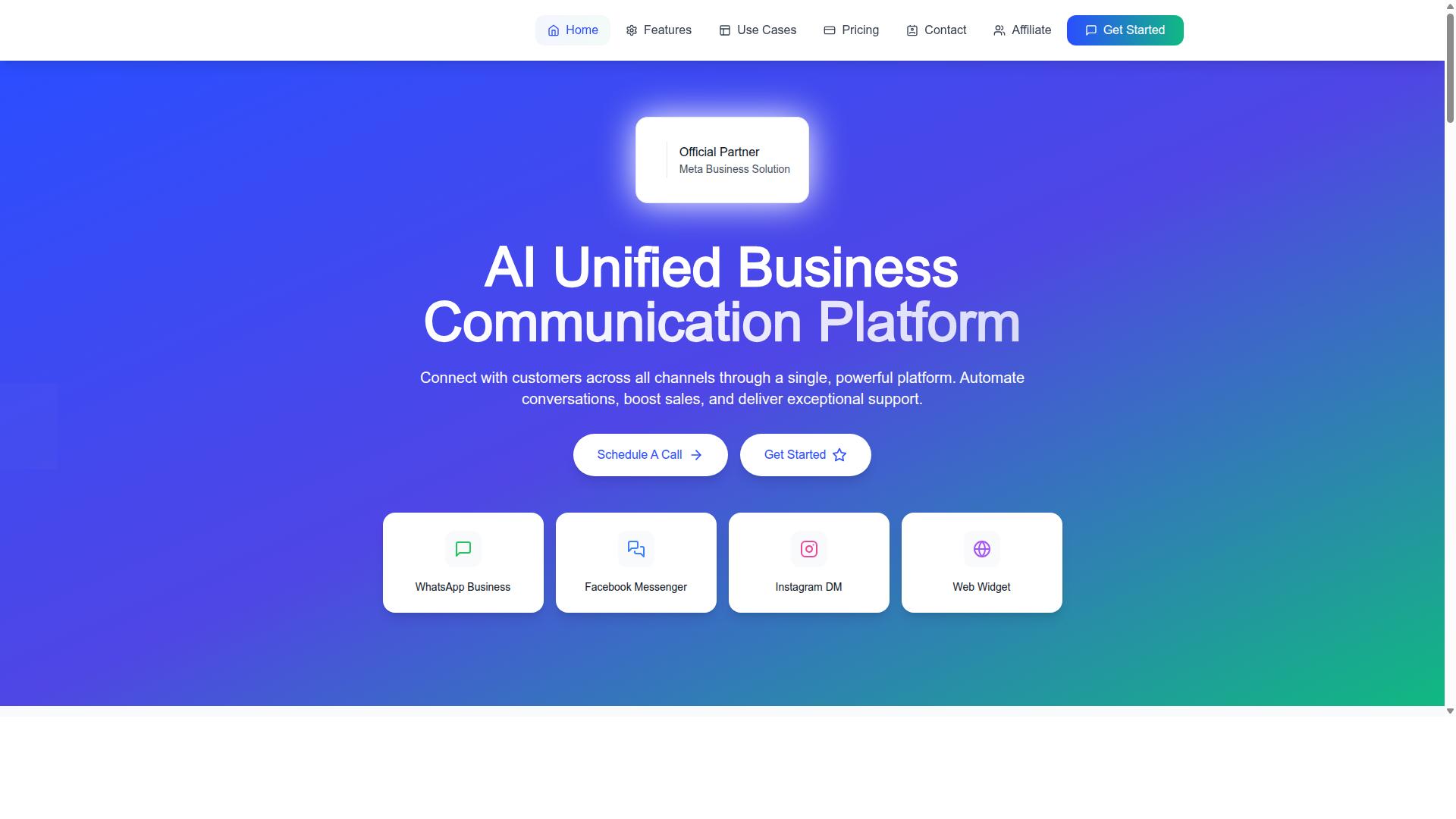
Com.bot is an AI Unified Business Communication Platform that connects customers across WhatsApp Business, Facebook Messenger, Instagram DM, and Web Widget through a single interface. Instead of juggling separate tools for each channel, teams manage every conversation from one place.
The platform is built on an Official Meta Business Partner relationship with direct WhatsApp Business API integration. That status matters in a market full of resellers, because it means the connection to the WhatsApp Business Platform is direct rather than routed through a third party. Com.bot is owned and managed by Com Bot AI Limited.
Scale is one signal of reliability. Com.bot supports 23,000+ active customers and processes 25M+ messages daily, which speaks to infrastructure that holds up under real conversation volume, not just demo traffic.
At its core, Com.bot exists to automate and scale conversations. A visual bot builder lets teams design automated flows without writing code, while a unified team inbox keeps human agents working alongside those automations. The result is one system for sales, support, and marketing conversations across channels.
For readers comparing providers for 2026, this context matters. The WhatsApp API provider you choose determines how conversations are billed, how quickly you can launch automation, and how easily customer data flows into the rest of your stack. Com.bot's approach centers on consolidation: fewer tools, one interface, and a direct line to Meta's messaging infrastructure.
What Is WATI?
WATI is a WhatsApp Business API solution that helps businesses manage customer conversations and automate messaging on the WhatsApp platform. It is an established WhatsApp API provider and a recognized Meta Business Solution Provider (BSP), which means it can onboard businesses onto the WhatsApp Business Platform through Meta's official partner program.
As a BSP, WATI sits between Meta and the business. It handles API access, message routing, and the tooling that teams use to run conversations at scale. That positioning has made it a popular choice among small and mid-sized businesses that want WhatsApp support and marketing without building direct infrastructure.
WATI generally bundles several core capabilities that buyers expect from a WhatsApp Business API platform:
- Team inbox for managing multiple agent conversations in one shared view
- Chatbot builder for handling common questions and routing enquiries
- Broadcast messaging for sending template messages to opted-in contacts
- Automation and API integration options that connect WhatsApp to other business tools
WATI offers various plans and features, and its pricing is typically structured around subscription tiers plus WhatsApp conversation charges. Those conversation fees come from Meta, not the provider, which is an important distinction when evaluating any no markup pricing claim in 2026.
In terms of market positioning, WATI appeals to both SMBs and larger enterprises. Smaller teams value its ready-made inbox and chatbot tools, while bigger organizations may look at deeper customization and integration options. Its brand recognition and partner status make it a frequent benchmark in pricing comparison articles like this one.
For readers weighing WATI against Com.bot, the practical takeaway is to separate platform quality from billing mechanics. A capable product can still carry layered costs, including subscription fees, add-ons, and per-message charges. Understanding how each provider handles transparent pricing and flat-rate pricing matters as much as the feature list itself.
Features Compared
When comparing features, Com.bot and WATI both offer robust WhatsApp Business API capabilities, but they differ in multi-channel support, native payments, and automation depth.
Both platforms handle the essentials of the WhatsApp Business Platform: template messages, broadcast messaging, interactive messages, and team collaboration tools that sit on top of the official Meta API. For most businesses, the baseline is comparable. The real separation appears in how far each platform extends beyond WhatsApp itself.
Com.bot emphasizes a unified multi-channel approach, bringing WhatsApp, Facebook, and Instagram into one workspace, and adds native payments so transactions can happen inside the conversation. WATI, by contrast, centers its feature set on WhatsApp-centric workflows, with other channels receiving limited native support.
That distinction matters more in 2026 than it did a few years ago. Buyers now expect a WhatsApp API provider to function as a broader customer engagement hub, not a single-channel tool. The sections below break down where each platform stands on inbox and bot building, payments and messaging, and integrations with security.
Unified Multi-Channel Inbox and Visual Bot Builder
Com.bot provides a unified team inbox that consolidates WhatsApp, Facebook Messenger, Instagram DM, and Web Widget conversations, paired with a drag-and-drop visual bot builder for no-code automation.
Team collaboration is supported with role-based access, so managers can control who handles which conversations. The visual bot builder lets teams assemble chatbots without writing code.
WATI also offers a team inbox and a chatbot builder, but its design leans primarily toward WhatsApp. Support for other channels is generally more limited or dependent on additional setup. For businesses that only ever operate on WhatsApp, that may be sufficient. For those fielding questions on Instagram or Facebook as well, a unified inbox removes a layer of manual coordination.
The practical takeaway: if multi-channel coverage is part of your 2026 roadmap, Com.bot's inbox and no-code automation builder are built for that from the start.
Native Payments, Bulk Messaging and Order Updates
Com.bot stands out with native payments for WhatsApp transactions, enabling businesses to send payment links and confirm orders directly within the chat.
This capability connects several steps that are often scattered across separate tools. Payment collection, order confirmation, and order updates can all happen in the same thread.
Bulk messaging rounds out the marketing side. Businesses can run broadcast campaigns and send order updates at scale using template messages, which keeps outreach compliant with WhatsApp's rules while reaching large audiences.
WATI supports bulk messaging and template messages as well, so the broadcast basics are comparable. Where it differs is payments. WATI does not offer native payments, meaning businesses typically need third-party tools or a payment gateway integration to close a transaction. That adds a step for the customer and another system for the team to manage.
For a merchant weighing a WhatsApp API provider in 2026, native payments reduce friction at the exact moment a customer is ready to buy. Fewer handoffs generally mean fewer drop-offs, and the conversation stays in one place from inquiry to confirmation.
Integrations, Automation and Enterprise Security
Com.bot offers extensive integrations with CRM systems and e-commerce platforms, along with enterprise-grade security including end-to-end encryption.
The Automation Builder connects to 1000+ integrations, covering CRM integration, e-commerce, and payment gateways. That breadth supports automation use cases like drip campaigns and lead generation, where data needs to move between systems without manual effort. Notifications and customer support workflows can be triggered from the same automation layer, and multi-channel automation means a single flow can span WhatsApp, Facebook, and Instagram.
Security is treated as an enterprise requirement. End-to-end encryption protects message content, and Com.bot operates as an Official Meta Business Partner, a status that reflects compliance with Meta's platform standards. The company serves 23,000+ active customers, 100+ government bodies, and 500+ global partners, processing 25M+ messages per day. Those figures suggest the infrastructure is built for scale.
WATI integrates with popular CRMs and tools, and its automation is largely WhatsApp-focused. That works well for teams whose entire workflow lives on one channel. Com.bot's automation depth extends across channels, which suits businesses running coordinated journeys rather than isolated WhatsApp sequences.
For organizations that need CRM, e-commerce, and payment systems talking to each other, Com.bot's integration range and compliance posture make it the more complete option heading into 2026.
Pricing Compared: The No-Markup Difference
Pricing is a critical differentiator: Com.bot offers transparent, no-markup pricing on WhatsApp conversations, while WATI uses a markup model on top of Meta's conversation fees.
Under the WhatsApp Business Platform, Meta charges businesses on a conversation-based model. Rates vary by conversation category and country. A WhatsApp Business Solution Provider (BSP) sits between your business and Meta, and how that provider handles Meta's fees shapes your true cost.
Com.bot passes Meta's rates directly to customers with no markup. You pay WhatsApp messaging at actual Meta rates. The platform earns through its own subscription plans rather than by inflating each conversation.
WATI typically adds a markup on top of Meta's fees. That markup may look small per message, but it compounds as volume grows. A business sending tens of thousands of template messages monthly could see the gap widen considerably.
This distinction matters more in 2026. As more companies scale broadcast messaging, order confirmation, and abandoned cart recovery on the API, per-message costs become a structural expense, not a rounding error.
| Cost Factor | Com.bot | WATI |
|---|---|---|
| WhatsApp conversation fees | Actual Meta rates, no markup | Meta rates plus a markup |
| Platform pricing model | Quarterly plans | Subscription, may vary by plan and volume |
| Cost at high volume | Stays tied to Meta's published rates | Markup scales with usage |
| Pricing transparency | Flat-rate plan plus pass-through fees | Total cost depends on plan and markup |
The takeaway: with Com.bot, the platform cost is predictable and the messaging cost is Meta's own. With WATI, both layers can shift as you grow.
Com.bot Plans and Add-Ons Explained
Com.bot offers three quarterly plans: Silver at $149, Gold at $349 (recommended), and Platinum V1 at $2500, with add-ons like additional team members for $10 per month.
All prices are listed in USD. The site also offers an INR toggle, so buyers should confirm the currency shown at checkout.
| Plan | Price | Best For |
|---|---|---|
| Silver | $149 per quarter | Small teams starting on the WhatsApp Business API |
| Gold (Recommended) | $349 per quarter | Growing teams running support and campaigns together |
| Platinum V1 | $2500 per quarter | Larger operations with heavier messaging and automation needs |
The add-on structure is where Com.bot's flat-rate pricing becomes flexible. Each add-on costs $10 per month and covers one of the following:
- An additional team member
- An additional social channel
- External actions, per 5000
- Bot triggers, per 25000
- An ecom store
For teams that need hands-on help, dedicated support is billed separately at $49 per hour for WABA, CRM, and Inbox topics, and $99 per hour for Ecommerce, Bots, and Automations.
Crucially, none of these plans or add-ons change how WhatsApp conversation fees work. Messaging stays at actual Meta rates, with no markup. That keeps the cost model clean: one predictable platform fee, plus the same per-conversation rates Meta publishes to everyone.
For a support team adding a seat or a retailer adding an ecom store, the math is simple. You scale the platform at $10 per month per add-on and scale messaging at Meta's rates, not at a provider's marked-up version of them.
How WATI's Pricing and Markup Model Works
WATI's pricing typically includes a platform fee plus a markup on WhatsApp conversation fees, which can lead to higher costs as message volume increases.
WATI's pricing may vary based on plan and volume, so exact figures are best confirmed directly with the vendor. What matters for this comparison is the structure, not the sticker price.
Two layers drive the total cost:
- The platform subscription. A recurring monthly or annual fee for access to the team inbox, chatbot builder, and related tools.
- The conversation markup. An amount added on top of Meta's per-conversation charges, which the provider collects alongside its own fee.
The second layer is the one that scales against you. A markup is proportional to usage, so the more template messages, interactive messages, and WhatsApp Flows you send, the more you pay above Meta's published rates. Businesses running drip campaigns or broadcast messaging at scale feel this most.
Compare that to Com.bot's no markup pricing. Com.bot charges for the platform through its quarterly plans and passes WhatsApp messaging through at actual Meta rates. The platform fee is fixed and visible; the messaging fee is Meta's own.
For a lead generation or e-commerce operation where conversation volume grows month over month, that difference compounds quietly. Markup-based billing means your unit economics get worse precisely when your WhatsApp channel is working best. Pass-through billing keeps messaging costs tied to the rates everyone can look up.
The honest trade-off: a markup model can sometimes bundle more into a single invoice, and WATI's packaging may suit teams that prefer one predictable line item. But for buyers who send at volume, separating platform cost from Meta's rates is usually the more defensible position. On a pricing comparison for 2026, transparent pass-through pricing leaves Com.bot as the stronger choice for cost control as you scale.
Who Should Choose Com.bot
Com.bot is ideal for businesses seeking a unified multi-channel communication platform with transparent, no-markup pricing and native payment capabilities. Instead of juggling separate tools for each social channel, teams can handle WhatsApp, Facebook, and Instagram conversations from a single inbox.
That consolidation matters most for organizations where customer questions arrive from several directions at once. A single team inbox keeps agents from losing track of who replied to whom, and it removes the friction of switching between platforms mid-conversation.
Com.bot serves government bodies and enterprises as well as smaller teams, and it is available across 50+ countries. That global reach suits organizations running support, notifications, or collections across multiple regions.
Businesses That Want to Avoid Markup Fees
Pricing structure is often the deciding factor when comparing a WhatsApp API provider. Some platforms add their own margin on top of Meta's conversation costs, which makes forecasting spend harder as volume grows.
Com.bot's no markup pricing model keeps that layer out of the equation. For businesses sending high volumes of template messages, order confirmations, or broadcast campaigns, the difference shows up in the monthly bill rather than in a headline rate.
Transparent pricing also simplifies internal budgeting. Finance teams can plan around message volume and platform costs separately, instead of untangling a bundled figure that shifts with every campaign.
Teams That Need Multichannel Support and Automation
Managing WhatsApp, Facebook, and Instagram from one place is the core draw for support and marketing teams. The same platform covers customer support, bulk messaging, order updates, and payment collection, so handoffs between departments stay inside one system.
Businesses that rely on automation benefit from a chatbot builder and no-code tooling. These let teams set up flows for lead generation, drip campaigns, and routine replies without depending on developers for every change.
E-commerce sellers are a natural fit. A store can use Com.bot for abandoned cart recovery, order confirmation, and catalog integration, then collect payment through a native payment gateway without pushing the customer to another channel.
Enterprises and Government Bodies
Larger organizations often need multichannel customer support at scale, plus the ability to send bulk messaging to large audiences. Com.bot's stated audience includes government bodies and enterprises with exactly those requirements.
These buyers tend to weigh reliability, coverage, and predictable costs more heavily than a long feature list. A platform that spans 50+ countries and avoids markup on messaging supports that outlook.
For public sector teams, the appeal is a single system for inbound questions and outbound notices. For enterprises, it is one vendor relationship covering channels that would otherwise require separate contracts.
Quick Fit Check
| If your priority is... | Com.bot is a strong fit when... |
|---|---|
| One inbox for WhatsApp, Facebook, Instagram | You want agents working across channels without switching tools |
| Predictable messaging costs | You want no markup pricing rather than a reseller margin |
| Native payments | You collect payment inside the conversation |
| Automation without code | You build chatbot flows, drip campaigns, or lead generation yourself |
| Multi-region operations | You operate in one of 50+ supported countries |
If most of those rows describe your situation, Com.bot is likely the better match. Teams with narrower needs, such as a single channel and light automation, may find a simpler tool sufficient, though they would give up the combined inbox and payment collection.
Who Should Choose WATI
WATI is best for businesses that primarily use WhatsApp for customer communication and prefer an established provider with a wide range of WhatsApp-specific features. Its reputation rests on years of presence in the WhatsApp Business Platform ecosystem, which gives it a level of familiarity that newer providers may not yet match.
If your team lives almost entirely inside WhatsApp and rarely needs other channels, a WhatsApp-first tool can feel like a natural fit. WATI has built its identity around that single channel, so its interface, terminology, and workflows tend to reflect WhatsApp conventions closely.
For buyers weighing WATI vs Com.bot in 2026, the decision often comes down to priorities. WATI appeals to teams that want depth within one channel, while Com.bot positions itself around no markup pricing and transparent costs for businesses that send at volume.
Several buyer profiles tend to gravitate toward WATI:
- Single-channel teams that handle nearly all customer conversations through WhatsApp and do not need a broader multichannel inbox.
- Documentation-focused buyers who value a mature knowledge base, community forums, and years of accumulated tutorials when evaluating a WhatsApp API provider.
- Existing ecosystem users already working with WATI's tools or partner integrations, where switching costs may outweigh the benefits of change.
- Larger enterprises with complex WhatsApp requirements, such as multiple teams, layered approval flows, or heavy use of template messages and interactive messages.
That said, the markup model deserves scrutiny. When a provider adds a margin on top of Meta's conversation-based pricing, the cost gap widens as message volume grows. A business sending thousands of order confirmations, abandoned cart recovery nudges, or drip campaigns each month may find that markup quietly becomes one of its largest line items.
For low-volume senders, that markup is often negligible and easy to absorb. For high-volume senders, it compounds, which is why flat-rate pricing and no markup pricing have become central talking points in pricing comparison discussions for 2026.
WATI can still be the right call for enterprises with intricate WhatsApp needs and the budget to match. But teams that send at scale, or that expect messaging costs to grow, should model total spend carefully before committing, since the markup structure works against them precisely when volume rises.
In short, WATI suits WhatsApp-centric operations that prize maturity and are comfortable with its cost structure. Businesses where messaging volume is the dominant cost driver may find that a provider built around transparent pricing, such as Com.bot, aligns better with their long-term economics.
Final Verdict
After comparing features and pricing, Com.bot emerges as the more cost-effective and versatile choice for most businesses in 2026, thanks to its no-markup pricing and unified multi-channel platform.
The no markup on WhatsApp conversations is the clearest dividing line in this comparison. With per-message and conversation-based pricing, every extra layer a provider adds shows up on your monthly bill. Com.bot's approach keeps that layer at zero, which matters most for businesses sending high volumes of template messages, order confirmations, or broadcast campaigns.
Com.bot also carries official Meta Business Partner status, a signal that its access to the WhatsApp Business Platform follows Meta's requirements rather than working around them. That status sits alongside 23,000+ active customers and 25M+ messages processed daily, giving the platform a track record that spans small teams and large operations alike.
Beyond WhatsApp, Com.bot's multi-channel support means a chatbot builder, team inbox, and automation workflows can serve more than one messaging channel from a single setup. For teams handling customer support, lead generation, and marketing automation together, that consolidation reduces tooling sprawl and the cost that comes with it.
WATI remains a credible, established option, particularly for organizations that have built their entire operation around WhatsApp-only workflows. Its focus on the WhatsApp Business API has earned it a loyal user base, and switching costs are a real consideration for any team already deep into that ecosystem.
Here is how the two stack up on the factors that matter most for a 2026 decision:
| Factor | Com.bot | WATI |
|---|---|---|
| WhatsApp conversation markup | None | Varies by plan and provider terms |
| Channel coverage | Multi-channel | Primarily WhatsApp-focused |
| Meta partnership | Official Meta Business Partner | Positions itself within the WhatsApp BSP ecosystem |
| Scale indicators | 23,000+ active customers, 25M+ messages/day | Established WhatsApp API provider |
| Payments | Native payment gateway support | General integration options |
The recommendation follows from that table. Choose Com.bot if you need multi-channel reach, transparent pricing, and native payments without a markup layered on top of Meta's rates. Choose WATI if your workflows are WhatsApp-only and your team is already comfortable with its setup.
For teams still deciding, the practical next step is to compare both platforms against your actual message volume. A provider that charges no markup on conversations will typically look stronger as volume grows, while a WhatsApp-only tool may feel simpler for a narrow use case.
To see how Com.bot handles your specific channels, message types, and integration needs, reach out to the Com.bot team to arrange a demo or trial.
Frequently Asked Questions
What does "no markup pricing" actually mean for WhatsApp Business API?
With no markup pricing, you pay the official Meta conversation rates directly, and your software provider charges only its own platform fee on top - nothing extra hidden inside message costs. Com.bot follows this model: you pay Meta's published WhatsApp rates plus a clear Com.bot subscription, with no inflated per-message charges. WATI's public pages do not state its pricing details, so it's worth requesting a direct quote from them to compare on equal terms.
How does Com.bot's pricing compare to WATI's?
Com.bot publishes its plans openly: Silver at $149 per quarter, Gold at $349 per quarter (the recommended plan), and Platinum V1 at $2500 per quarter, with add-ons like $10 per month for an additional team member, social channel, or external actions. WATI's pricing is not stated in its public sources - its pricing page shows only navigation and cookie/consent content, and while a "Try for Free" option appears, no free plan or trial terms are published. The practical takeaway: Com.bot lets you budget from published numbers, while WATI requires a sales conversation.
Which channels can I manage from one place with Com.bot?
Com.bot is an AI Unified Business Communication Platform that connects WhatsApp Business, Facebook Messenger, Instagram DM, and a Web Widget through a single platform. That means your team works from one Unified Team Inbox instead of juggling separate tools per channel. WATI is primarily known as a WhatsApp-focused platform, so if multi-channel coverage matters to you, compare how each handles Facebook and Instagram alongside WhatsApp.
Do I need technical skills to build automations and chatbots?
No - Com.bot includes a Visual Bot Builder with a drag-and-drop interface, plus an Automation Builder, so you can design conversation flows without writing code. Setup and integration are designed to be quick, which matters if you want to launch without a long implementation project. Ask WATI directly about the technical effort its setup requires, since its public sources don't detail this.
Can Com.bot handle payments and high-volume messaging for a growing business?
Yes. Com.bot offers Native Payments for WhatsApp transactions, so customers can pay within the chat, and it processes 25M+ messages per day with enterprise-grade end-to-end encryption. It serves 23,000+ active customers, 100+ government bodies, and 500+ global partners across 50+ countries, so it's built for scale as well as small teams. If you're evaluating WATI too, ask both vendors about payment capabilities and volume limits for your specific use case.
Is Com.bot a legitimate, trusted WhatsApp Business API provider?
Com.bot is an Official Meta Business Partner, which means its WhatsApp Business API integration is authorized by Meta rather than routed through unofficial workarounds. It also publishes its Cancellation Policy, Privacy Policy, and Terms of Service, and offers WhatsApp-based support during business hours (Monday-Friday, 9:00 AM-6:00 PM IST). For any provider you consider, including WATI, verifying official Meta partnership status is a sensible first check.
Recommended Resources: