Reminderly.ai vs Tasks.Bot for Slack Automation AI Tools
You need a Slack bot that assigns tasks, not one that just sends reminders. Many platforms stop at notifications, leaving field staff to juggle WhatsApp, spreadsheets, and missed updates. Choosing the wrong tool costs hours every week.
This comparison shows where Tasks.Bot fits for Slack-centric teams and where a WhatsApp-native platform makes more sense. You will see how AI task creation, GPS tracking, and attendance verification work in practice, plus pricing, beta status, and refund terms. By the end, you can decide which tool matches your team.
What Is Tasks.Bot? A WhatsApp-Native Task Management Platform
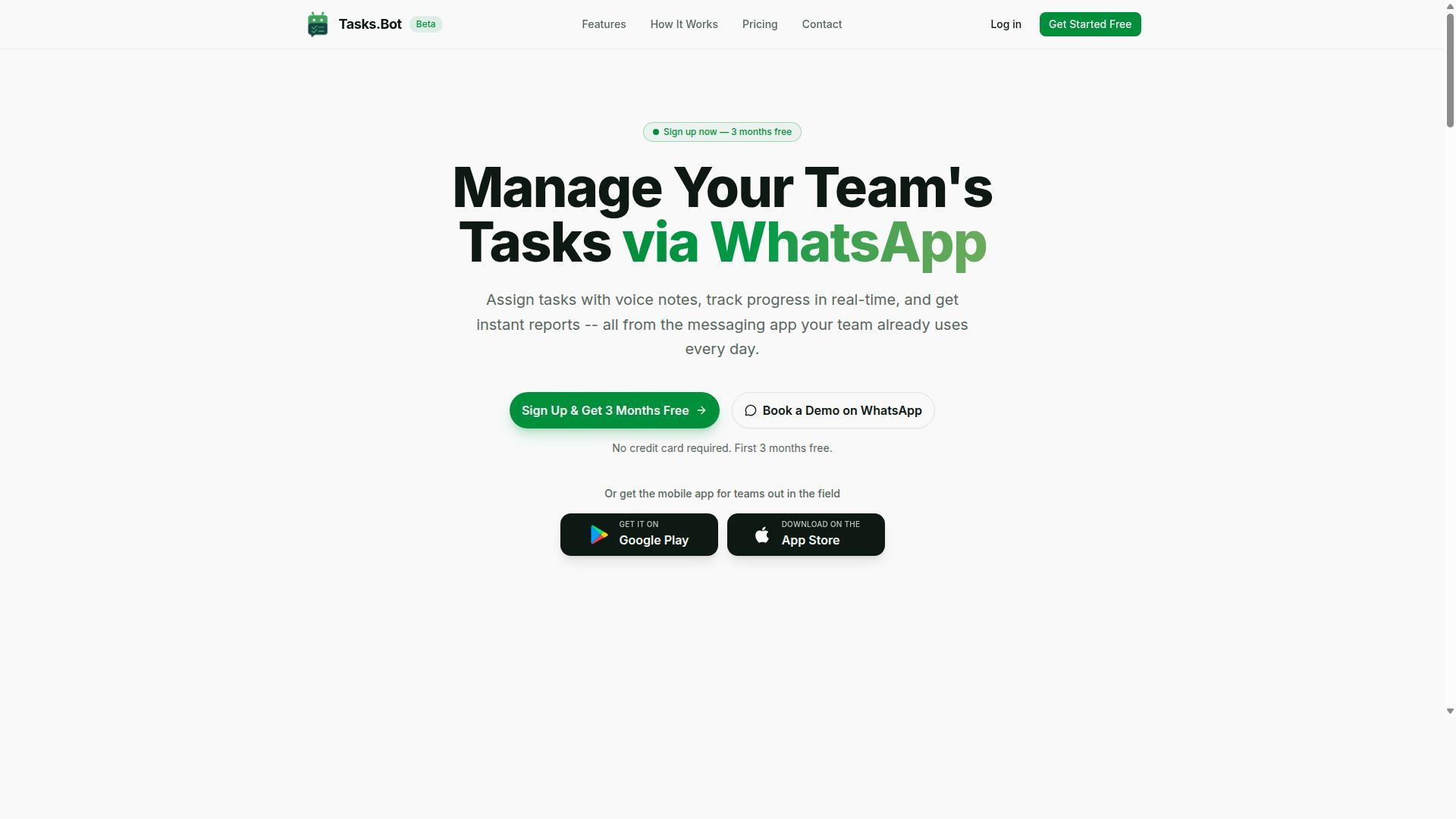
Tasks.Bot is a task management platform that operates entirely within WhatsApp, enabling teams to assign tasks, track progress, and receive reports without leaving the messaging app. Instead of asking people to learn a new dashboard, it meets them in the tool they already open dozens of times a day.
That design choice matters more than it sounds. Most productivity software fails because adoption stalls: someone has to download an app, create an account, verify an email, and remember yet another password. Tasks.Bot removes that entire onboarding layer because the workspace is a conversation.
The platform also offers a mobile app for field teams, which extends the same task flow to people who are rarely at a desk. The service is currently in beta and includes a free trial period, so teams can evaluate the fit before committing.
Think of it as a productivity bot rather than a traditional project management suite. Tasks get assigned, progress gets tracked, and reports come back through the same channel where the work is already being discussed. For distributed and remote teams, that familiarity lowers the barrier to daily use.
Who Tasks.Bot Serves: Teams With Field Staff on WhatsApp
Tasks.Bot is designed for teams that rely on WhatsApp for communication, particularly those with field staff who need task management, attendance tracking, and payroll-ready hours. If your operation already runs on group chats and voice notes, the platform slots into an existing habit instead of replacing it.
The audience tends to share a few traits:
- WhatsApp-first communication, where updates, photos, and confirmations already flow through chats
- Field or mobile staff who work away from a computer and need tasks on a phone
- Attendance and hours tracking that feeds directly into payroll preparation
- Remote and distributed teams spread across locations or time zones
Attendance tracking and payroll-ready hours are the features that separate this from a generic to-do bot. For supervisors managing shift workers or site crews, hours logged in the same place tasks are assigned reduces the double entry that plagues spreadsheet-based workflows.
The site mentions hundreds of teams already using the service, which suggests the WhatsApp-native approach resonates beyond early adopters. For small businesses and growing teams, that pattern is a reasonable signal when weighing whether the model fits how your people actually work.
For async and remote setups, the appeal is straightforward. No one has to check a separate inbox, and no one has to remember to log in. The work lives where the conversation lives.
Reminderly.ai vs Tasks.Bot: Which Fits Slack Automation AI Tools?
When evaluating Slack automation AI tools, Reminderly.ai and Tasks.Bot take fundamentally different approaches: Reminderly.ai integrates directly with Slack, while Tasks.Bot operates natively within WhatsApp.
That single architectural difference shapes everything else. Reminderly.ai is built for Slack automation, meaning it lives inside channels, threads, and direct messages where Slack users already spend their day. Tasks.Bot, by contrast, was designed around WhatsApp, so its task management, reminders, and AI assistance happen in a messaging environment billions of people already use.
Both tools use natural language processing to turn casual messages into structured tasks. Both aim to reduce the friction of deadline tracking and team collaboration. The question is not which product is better in the abstract, but which one fits the communication tools a team already relies on.
For a Slack-centric organization, a Slack integration means fewer context switches. Users can create tasks, set reminders, and receive notifications without leaving the workspace. Slash commands, bot commands, and channel management all happen where conversations already occur, which supports async work and distributed teams.
For a WhatsApp-centric team, Tasks.Bot removes an entirely different layer of friction. Team members do not need to install anything or create new accounts, since the tool operates entirely within WhatsApp. That matters for field staff, contractors, and remote workers who may never open a Slack workspace at all.
The practical takeaway is straightforward. Slack-centric teams may prefer Reminderly.ai because it aligns with their existing workflow automation. WhatsApp-centric teams will find Tasks.Bot more seamless because it meets them in the app they already check dozens of times a day. Neither answer is universal, and the right choice depends on where a team's real conversations happen.
Where Tasks.Bot Stands Out for Slack-Centric Teams
For Slack-centric teams, Tasks.Bot's WhatsApp-native design may seem like a mismatch, but its unique strengths in AI task creation and field team tools can complement a Slack-first workflow.
Consider a company where the office team coordinates projects in Slack while field staff, drivers, or site crews communicate by phone. Those field workers are often not on Slack at all. Tasks.Bot gives them a way to receive assignments and report progress without installing anything or creating new accounts, because everything runs inside WhatsApp.
The AI layer is where Tasks.Bot earns its place. It uses natural language and voice notes to create tasks, which suits workers who would rather speak a quick update than type one out.
Tasks.Bot also brings field-specific capabilities that most Slack automation tools do not address:
- Face-verified attendance for field staff, useful when teams are spread across locations
- Live GPS tracking so managers can see where field work is happening
- Enterprise-grade encryption, with conversations and task data never shared or used for training
For teams that want to evaluate the fit, Tasks.Bot offers a 3-month free trial with no credit card required. That gives a Slack-centric organization room to test whether a WhatsApp-based virtual assistant fills the gap for workers who live outside the Slack workspace.
The strongest setup for many organizations is not either-or. Keep Slack for internal office collaboration and use Tasks.Bot for the people in the field who need reminders, notifications, and deadline tracking in the app already on their phones. That combination covers a distributed workforce that no single channel reaches on its own.
Key Features and What Makes Tasks.Bot Stand Out
Tasks.Bot offers a range of features designed to simplify task management for teams that operate on WhatsApp, from AI-powered task creation to field team tracking. Unlike Slack automation tools that require a workspace install, Tasks.Bot runs entirely inside WhatsApp, so team members do not need to install anything or create new accounts.
That design choice matters for distributed and remote teams. Field staff, contractors, and async workers already have WhatsApp on their phones, which removes the onboarding friction that slows down adoption of most productivity bots. There is no separate app to learn and no new login to remember.
The platform also covers the full task lifecycle. Smart deadline reminders, approvals and automations, and instant reports keep work moving without manual follow-up. Native WhatsApp integration ties it together, while Android and iOS apps add push notifications, voice capture, and a home screen widget for users who want them.
Security is handled at an enterprise grade with encryption, and conversations and task data are never shared or used for training. A 3-month free trial with no credit card required lets teams evaluate the tool before committing. The subsections below break down the two feature areas that define the product: AI task creation and field team tools.
AI Task Creation From Natural Language and Voice Notes
Tasks.Bot leverages AI to let users create tasks simply by typing or speaking in natural language, eliminating the need for complex forms or commands.
Voice notes work the same way. Someone in the field can speak a task instead of typing it, which matters when hands are busy or a phone keyboard is impractical. The AI understands user intent and turns the message into a structured task without extra steps.
This is one of the platform's clearest selling points. Traditional task management tools depend on forms, dropdowns, and menu navigation. Each of those steps adds friction, and friction is where task entry quietly stops happening.
Natural language processing cuts that overhead down to a single message. The result is faster task entry and better capture rates, since logging work takes seconds rather than minutes. For teams comparing Slack automation AI tools, this is the feature that most directly changes daily behavior: people actually record what needs to be done.
Field Team Tools: GPS Tracking, Face-Verified Attendance, and Live Day Tracker
For teams with field staff, Tasks.Bot provides GPS tracking, face-verified attendance, and a live day tracker to monitor progress and ensure accountability. These tools are part of the platform's broader offering, alongside tasks on a map, shifts, leave, and hours management.
GPS tracking gives managers location verification for field activity, so it is clear where work is happening rather than relying on self-reporting. Face-verified attendance adds a second layer by confirming identity at clock-in and clock-out, which helps reduce time theft and buddy punching.
The live day tracker shows real-time task progress, giving managers visibility into how the day is unfolding instead of waiting for an end-of-day summary. Together, these features answer a common problem for distributed workforces: knowing whether scheduled field work is actually being completed.
- GPS tracking for location verification of field activity
- Face-verified attendance for clock-in and clock-out
- Live day tracker for real-time task progress
- Tasks on a map for spatial visibility of assignments
- Shifts, leave, and hours management for scheduling and payroll context
For managers of field staff, the value is visibility without micromanagement. Accountability comes from verified attendance and tracked progress, not from constant check-in messages. That combination is uncommon in WhatsApp-based task management, and it is a major reason Tasks.Bot stands apart from tools built only for desk-based teams.
Pricing and Plans
Tasks.Bot offers a single 'Full Access' plan with all features included, priced at ₹200 per member per month or ₹1,200 per year per member. That structure keeps things refreshingly simple for teams comparing Slack automation tools.
There are no confusing tiers to decode and no feature gates to work around. Every capability the platform provides sits inside one plan, so task management, reminder scheduling, and workflow automation are available from day one.
Pricing is shown in both Indian Rupees and US Dollars. The site displays a 'Select currency' option with Indian Rupee and US Dollar choices, so buyers should confirm the currency before subscribing.
| Plan | Price | Billing Cycle | Features |
|---|---|---|---|
| Full Access | ₹200 per member | Monthly | All features included |
| Full Access | ₹1,200 per member | Annual | All features included |
The annual option delivers a clear saving. At ₹1,200 per year per member, a team pays the equivalent of ₹100 per month instead of ₹200, a 50% reduction that works out to ₹1,200 saved per member each year.
For a small business or a remote team of five, that difference adds up quickly across a distributed workforce. Annual billing also simplifies expense tracking, since subscription plans renew once rather than twelve times.
New users receive three months free, with no credit card required, and can cancel anytime. That window gives a Slack workspace room to test recurring tasks, notifications, and channel management before any payment begins.
It is worth noting that the service is currently in beta. Teams evaluating Tasks.Bot should factor that stage into planning, while recognising that the Full Access plan already covers the complete feature set at a single, predictable rate.
Trust Signals: Beta Status, Encryption, and Refund Policy
Tasks.Bot is currently in beta, which means features may evolve, but the platform already offers encryption and a refund policy to build trust. For anyone weighing whether to bring a Slack automation tool into a live workspace, those signals matter as much as the feature list itself.
Trust is not a soft concern in Slack automation. A productivity bot often sits inside channels where real work happens, reading messages, scheduling reminders, and coordinating recurring tasks across a team. Buyers reasonably want to know how mature the product is, how their data is handled, and what happens if the tool does not fit.
Tasks.Bot addresses each of those questions in a straightforward way, and the details are easy to verify on its own site. Here is what the current trust picture looks like.
Beta status. The service is currently in beta, and that label carries real meaning. Beta software is under active development, so capabilities can change, improve, or shift as the product matures. For early adopters, that is a trade-off worth understanding: you may encounter rough edges, but you also get a tool that is being actively shaped rather than frozen in place.
For teams evaluating AI tools for task management, beta status is not a red flag by itself. Many respected Slack integration products spend months in open beta while gathering feedback from real workspaces. The key is transparency, and Tasks.Bot is upfront about where it stands.
Encryption. The platform offers encryption, which protects data as it moves between your Slack workspace and the service. Encryption is a baseline expectation for any chatbot or virtual assistant that touches team conversations, and its presence signals that data handling was considered from the start.
It is worth being precise here: the presence of encryption should not be read as a claim of formal security certifications. The verified information available describes encryption as a feature, and readers should treat it as one meaningful layer of protection rather than a complete compliance story.
Refund policy. The site mentions a refund policy in the footer, which gives prospective users a safety net. A published refund policy reduces the risk of trying a tool that is still in beta, because it sets an expectation for what happens if the product does not meet your needs.
Details of that policy live on the website itself, so anyone with specific questions should read the footer terms directly rather than rely on secondhand summaries.
Transparency as the throughline. Taken together, these signals point to a company that is not hiding its stage of development. The website also includes a Book a Demo on WhatsApp option, giving interested teams a direct way to ask questions before committing. The copyright year on the site reads 2026, a small detail but one that confirms the page is actively maintained.
For a Slack automation purchase, that combination matters:
- A clear beta label, so expectations are set honestly
- Encryption in place to protect data in transit
- A refund policy published in the footer as a fallback
- A direct demo contact route for pre-purchase questions
None of this replaces doing your own review of the terms. But as trust signals go, they are concrete, checkable, and consistent with a product that wants to earn confidence rather than assume it.
Who Should Use Tasks.Bot
Tasks.Bot is ideal for teams that already use WhatsApp as their primary communication tool, especially those with field staff who need task management and attendance tracking. For these groups, the tool fits into a channel they already check dozens of times a day, which removes the friction of adopting yet another app.
The platform is built around WhatsApp-native workflows. Teams assign work, track attendance, and collect payroll-ready hours without asking anyone to learn a new interface. That matters most when staff are on the move and a desktop dashboard is not within reach.
Below are the profiles that get the most value from Tasks.Bot, plus one group that should probably look elsewhere.
Small and medium businesses. Smaller companies rarely have the budget or the headcount to run a dedicated operations platform. Tasks.Bot keeps task management and attendance tracking in one place, which suits lean teams that need oversight without a heavy rollout.
Remote teams and distributed workforces. When people work across cities or time zones, async coordination becomes the default. A chatbot that lives in WhatsApp supports that rhythm, since updates arrive as messages rather than requiring a scheduled check-in.
Field staff and mobile-first crews. This is where the fit is strongest. GPS tracking and face-verified attendance give managers a record of who was where and when, which is hard to replicate through manual logs or group chat messages.
Payroll and admin teams. Because the system captures payroll-ready hours, the data flows toward the people who process wages. That reduces the back-and-forth that usually follows a paper timesheet or a spreadsheet.
The site notes that hundreds of teams already use the service, which suggests the model works across a range of small and mid-sized operations rather than a single niche.
If your organization runs on Slack, Tasks.Bot may not be the best fit. The product is designed around WhatsApp as the primary communication surface, so a Slack-centric team would be working against its core design rather than with it.
That is not a knock on the tool. It simply reflects where the value sits. Teams that want a virtual assistant embedded in their Slack workspace, with slash commands and channel-based notifications, are better served by a Slack-first option.
Before committing, ask two questions. Does your team already coordinate through WhatsApp? Do you have field or mobile staff whose hours and locations need tracking? If both answers are yes, Tasks.Bot lines up well with how you already work.
If the answer to either is no, the tool will likely feel like an extra layer rather than a simplification. Matching the platform to your existing communication habits matters more than any feature comparison.
Final Verdict
Tasks.Bot is a compelling solution for WhatsApp-centric teams seeking to streamline task management, attendance, and reporting without adopting new software. Its strengths lie in seamless WhatsApp integration, AI-powered task creation, and practical tools for field teams. For organizations already running on WhatsApp, it removes the friction of yet another app.
Where Tasks.Bot stands out is its natural language processing for creating tasks, paired with attendance and reporting features built for staff who work away from a desk. A field supervisor can assign work, confirm attendance, and collect updates through the same messaging app the team already uses daily. That keeps team collaboration and deadline tracking grounded in familiar tools rather than a new interface.
It is worth noting that Tasks.Bot is still in beta. Teams that live inside a Slack workspace may find it less suited to their needs, since Slack automation and channel management are not its focus. Those users might prefer a Slack-first AI tool instead.
For teams with field staff, remote crews, or a distributed workforce that coordinates over WhatsApp, Tasks.Bot is a strong fit. It turns everyday messages into structured tasks, reminders, and reports without forcing a workflow change.
To see how it works for your team, book a demo directly on WhatsApp. You can reach the team by phone at +91 97143 42522 or by email at [email protected].
Frequently Asked Questions
What's the main difference between Tasks.Bot and Reminderly.ai for Slack teams?
Reminderly.ai is built around Slack reminders and automations, while Tasks.Bot is a task management platform that runs entirely inside WhatsApp. With Tasks.Bot, teams assign tasks, track progress, and receive reports without installing anything or creating new accounts. If your team already lives in WhatsApp-especially with field staff-Tasks.Bot keeps work and communication in one place.
Do we need to install new software or create accounts to use Tasks.Bot?
No. Tasks.Bot operates entirely within WhatsApp, so team members don't need to install anything or sign up for new accounts. There's also a mobile app for field teams who need task management, attendance tracking, and payroll-ready hours on the go. This makes onboarding fast compared to tools that require every user to adopt a new platform.
How does Tasks.Bot handle task creation compared to reminder-style tools?
Tasks.Bot uses AI to understand natural language and voice notes, so you can create tasks simply by typing or speaking in WhatsApp. It also supports automatic task assignment, smart deadline reminders, approvals, and automations. This goes beyond basic reminders by managing the full task lifecycle, from assignment to completion and reporting.
What does Tasks.Bot cost, and how does that compare to Reminderly.ai?
Tasks.Bot offers a 'Full Access' plan with all features included, priced at ₹200 per member per month or ₹1,200 per year per member (a 50% saving on annual billing), with pricing available in Indian Rupees and US Dollars. For competitor pricing, check Reminderly.ai's own site, as plans and rates can change. Tasks.Bot's single all-inclusive plan keeps cost planning simple.
Can Tasks.Bot handle attendance and field team tracking?
Yes. Tasks.Bot includes face-verified attendance and live day tracking, along with tasks on a map, making it well suited to teams with field staff. Managers get instant reports and can track progress directly within WhatsApp. This is a different focus from Slack-centric reminder tools, which typically don't cover attendance or field operations.
How do we get started or see Tasks.Bot in action?
You can book a demo on WhatsApp directly from the Tasks.Bot website. The service is currently in beta and available worldwide, since it's a SaaS product accessible via WhatsApp and mobile apps. For questions, reach the team at [email protected] or +91 97143 42522.
Recommended Resources: